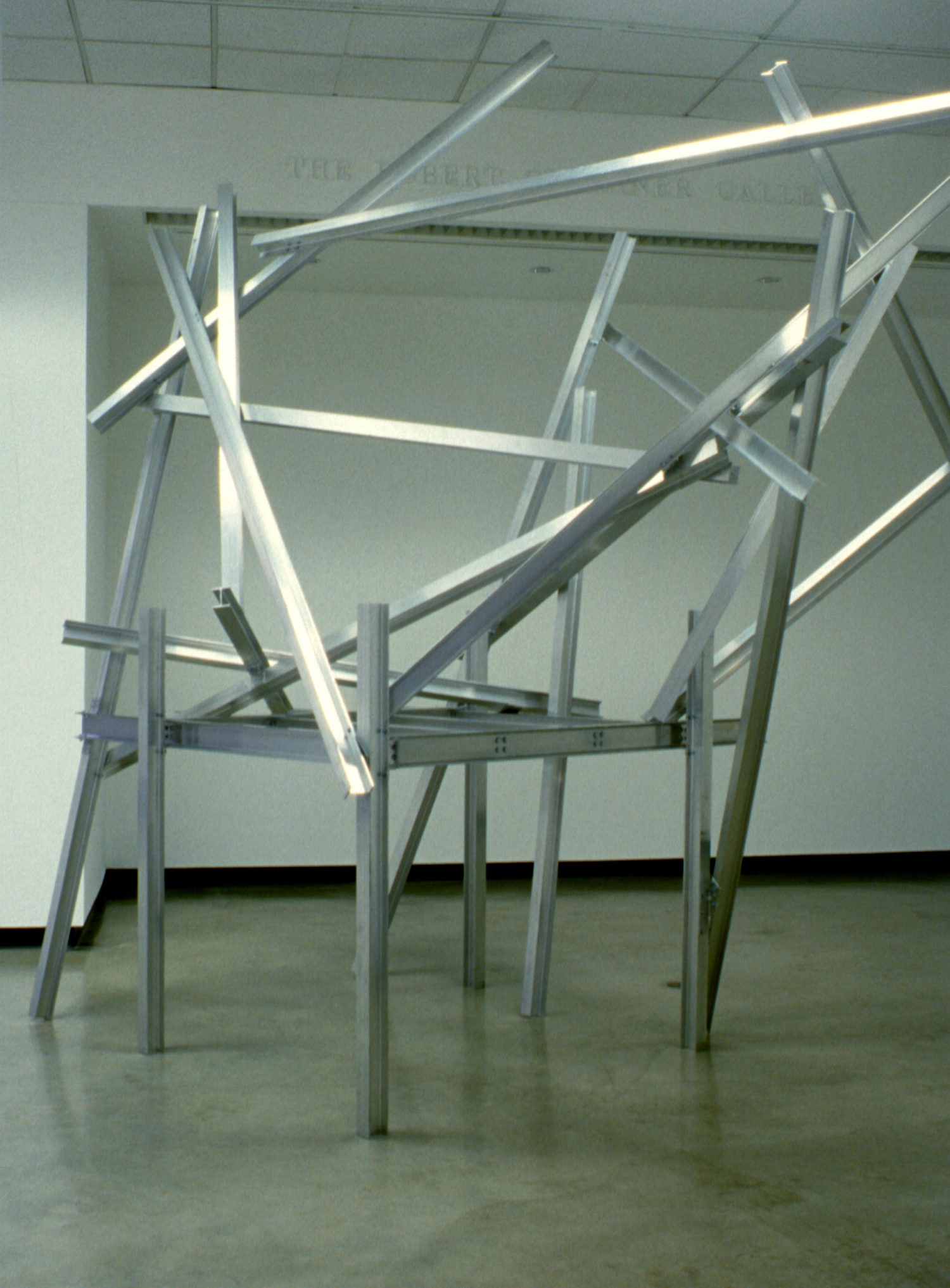
fabricated aluminum I-Beams, channel, angle, rivets, bolts, plate
14’ x 18’ x 16’
Long Beach Museum of Art, Long Beach, CA
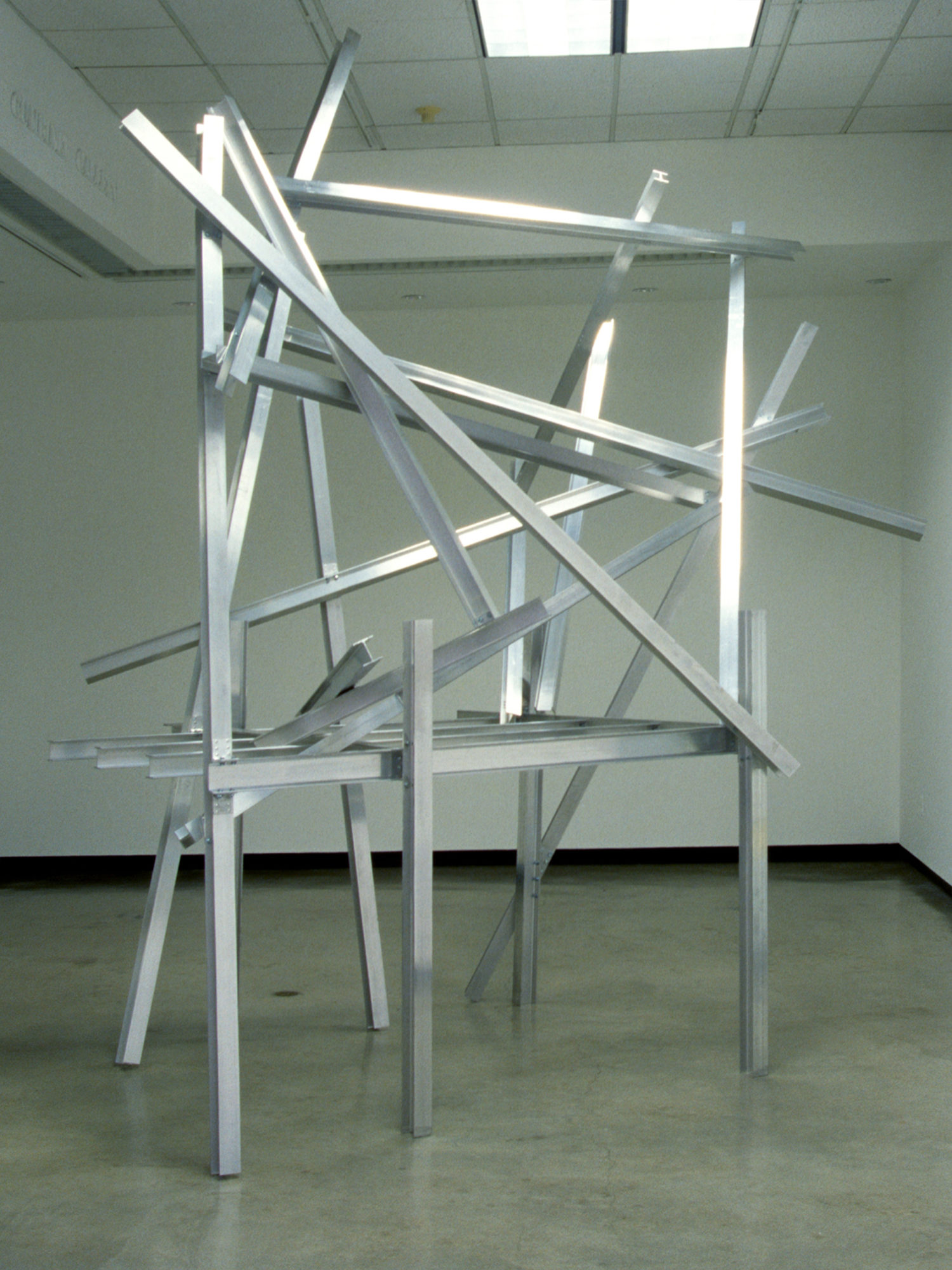
fabricated aluminum I-Beams, channel, angle, rivets, bolts, plate
14’ x 18’ x 16’
Long Beach Museum of Art, Long Beach, CA
A still image from a Three Stooges episode from 1940, titled How High is Up? was interpreted as a three dimensional sculpture.
The title How High is Up? is borrowed from a 1940 episode of the classic program The Three Stooges, which inspired Schafer to perform an in-depth analysis of one particular image. The Stooges, when hired as builders, are visited by the foreman who discovers that they have botched the job. The blunder, a structure made of I-beams pointing in various directions rather than at rational right angles, is shown full-screen as the punch line of a pure slapstick moment. However, Schafer notes that in a different context, the same image could be seen as an expression of Deconstructivist architecture, which introduced a spirit of ad-hoc-ism to the field in the 1980s. In fact, the Stooges’ object resembles elements of the Santa Monica house Frank Gehry designed for himself 1978, known for its deliberately slanted lines and randomly angled protrusions, an now considered a forerunner of a movement that favored anti-refinement. Schafer purposes that while in 1940—a time when elegant, Meisian perfection was becoming mainstream—the Stooges were considered imbeciles; forty years later they might have been considered visionaries. In order to make this point visually, Schafer translates the flat image from his TV screen into a fifteen-foot gleaming abstract sculpture and presents it in the context of the art museum. Schafer’s speculative sculpture, built at one-quarter scale, is two generations away from the original object that was no-doubt created for The Three Stooges set, purely for the purpose of comedic entertainment.
From the exhibition brochure text by Mary Kay Lombino.